

Trinity Magic Mushrooms: The Definitive Guide to Lineage, Potency, Morphology, and Cultivation
Introduction and Genetic Lineage
In the evolving world of mycology and specialized psilocybin breeding, few designer strains have commanded as much respect and curiosity as the Trinity magic mushroom. Trinity is an advanced, multi-strain hybrid belonging to the Psilocybe cubensis species. Crafted by expert underground breeders—most notably credited to Doma Nunzio of MagicMyco—the strain was developed with a specific intent: to fuse the most desirable traits of legendary, high-performance cultivars into a single, cohesive lineage.
The name “Trinity” carries a double meaning. First, it acknowledges its threefold genetic composition, born from a cross-pollination of three distinct parent strains: Penis Envy, Tidal Wave (itself a hybrid of B+ and Penis Envy), and Aztec God (or variants featuring close genetic relatives like True Albino Teacher in some sub-lineages). Second, the creator dubbed it “the bomb” referencing the historic Trinity nuclear test, pointing to the explosive potency and rapid developmental vigor packed into its genetics. For researchers, mycologists, and enthusiasts tracking the outer limits of cubensis evolution, Trinity represents a masterclass in modern fungal breeding.
Botanical Morphology and Physical Characteristics of Trinity Magic Mushrooms
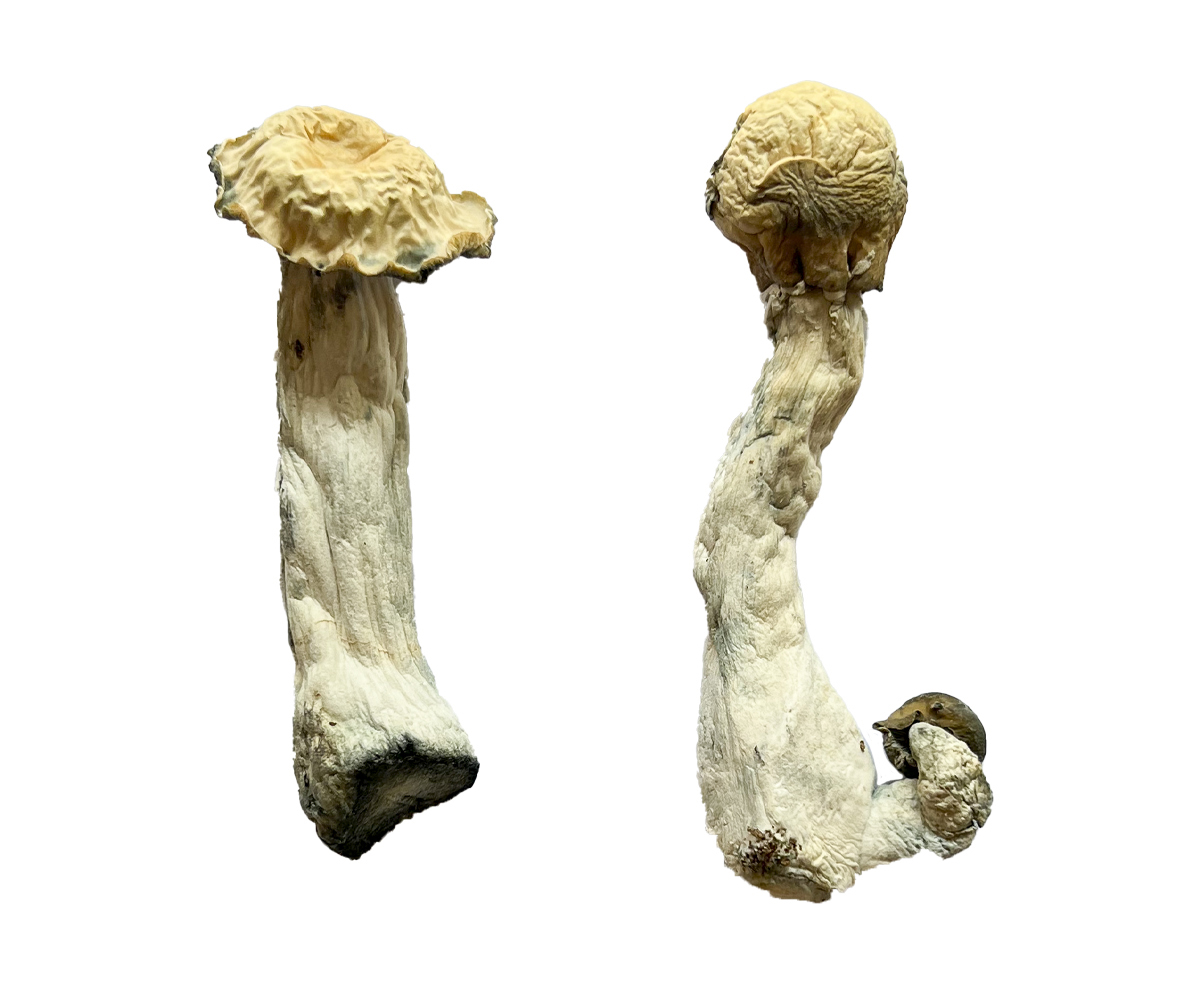
Because Trinity draws its heritage from powerhouse mutations like Penis Envy and Tidal Wave, its physical expression can be wonderfully diverse yet distinctively robust. It does not look like a standard wild-foraged baseline mushroom; instead, it exhibits heavy, dense structural phenotypes.
Key Visual and Structural Phenotypes
-
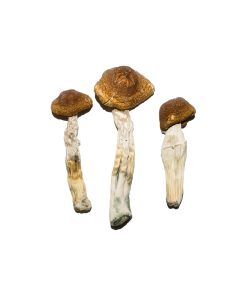
Cap Formation: Caps range from convex to broadly plane at maturity. They often feature smooth, thick textures that can appear slightly viscous or shiny when moist. Coloration shifts dynamically from deep golden-brown centers to lighter cream or pale yellow margins.
-
Stipe Architecture: Stems are typically thick, meaty, and substantial, designed to support heavy caps. While many fruit bodies mirror the classic stubby, bulbous look of Penis Envy, growers frequently encounter variations, including curved stems, wavy caps, and occasional dense mycological blobs or mutations in later flushes.
-
Bruising Dynamics: True to its high-potency lineage, any handling, cutting, or mechanical stress applied to the fresh fruit body triggers a rapid, deep blue-indigo bruising reaction due to the heavy oxidation of psilocybin compounds.
-
Spore Production: Spore deposits are dark purplish-brown, though certain heavily mutated or isolated substrains of Trinity can exhibit lighter spore drops or require specialized sterile collection techniques.
Chemical Profile and Potency Expectations
Trinity is widely recognized as a high-potency strain, sitting well above traditional baseline varieties like Golden Teacher or B+.
Alkaloid Concentration and Impact
-
Dry Weight Potency: Total active tryptamines (psilocybin, psilocin, and trace baeocystin) typically range from 0.8% to 1.2% by dry weight, with exceptional indoor grows testing even higher.
-
The Experience Profile: Because of its dense alkaloid profile inherited from Penis Envy and Tidal Wave, users and ethnobotanical reports describe Trinity as delivering an intense, deeply visual journey accompanied by strong somatic body warmth and profound emotional introspection.
-
Dosage Caution: Due to its elevated strength, standard dosing metrics applicable to regular cubensis strains can lead to unexpectedly intense experiences. Mycology researchers and experienced handlers approach Trinity with measured caution, noting that even minor adjustments in dry weight can significantly alter the depth of the session.
Cultivation Dynamics and Growth Parameters of Trinity Magic Mushrooms
Despite possessing complex designer genetics, Trinity has earned a strong reputation in cultivation circles for being surprisingly vigorous and manageable, provided basic sterile laboratory protocols are strictly maintained.
Essential Cultivation Guidelines
-
Colonization Vigor: The mycelium exhibits strong rhizomorphic growth, aggressively colonizing grain spawn (such as rye or millet) while building a robust natural defense against competing molds.
-
Substrate Preferences: Trinity thrives on standard bulk substrates, performing exceptionally well in coco coir-vermiculite (CVG) mixtures and pasteurized manure blends. Notably, the substrate tends to retain moisture efficiently, reducing the frequency of required misting during early cycles.
-
Temperature and Humidity: Optimal mycelial colonization occurs between 24°C and 27°C (73°F to 78°F). During the fruiting and pinning phase, maintaining a relative humidity of 90% to 95% alongside steady, reliable fresh air exchange (FAE) prevents fuzzy stipes and promotes healthy canopy development.
-
Flush Yields: When dialed in correctly, Trinity yields heavy, dense flushes. Expect multiple waves of harvest, though structural mutations and dense blobs are common anomalies during second and third flushes.
Frequently Asked Questions
What strains were crossed to create Trinity magic mushrooms?
Trinity is a complex triple-hybrid Psilocybe cubensis strain created by crossing Penis Envy, Tidal Wave (itself a hybrid of B+ and Penis Envy), and Aztec God.
How potent are Trinity magic mushrooms compared to standard strains?
Trinity is classified as a high-potency strain. While standard baseline strains like Golden Teacher typically test around 0.5% to 0.9% active compounds, Trinity averages between 0.8% and 1.2% total psilocybin by dry weight, making it significantly stronger.
What do Trinity mushrooms look like when harvested?
They closely resemble Penis Envy morphology, featuring thick, meaty stems and bulbous caps. However, because of its diverse genetic background, growers often notice a mix of standard shapes, wavy caps, and occasional mutations or dense blobs.
Are Trinity mushrooms difficult for beginners to cultivate?
While Trinity is a high-performance designer strain, its aggressive colonization speed and natural resilience make it surprisingly forgiving for cultivators who maintain proper sterile technique and environmental controls.
What is the origin of the name “Trinity”?
The name has a dual meaning: it honors the three parent strains used in its creation (Penis Envy, Tidal Wave, and Aztec God) and references the historic Trinity nuclear test because the creator considered the strain’s potent impact to be “the bomb”.
What kind of experience do users report from Trinity?
Users and community reports describe Trinity as providing an intense, deeply immersive experience characterized by vivid open- and closed-eye visuals, strong bodily euphoria, and profound philosophical introspection.
| Quantity | 14grams, Oz, Qp, Hp, 1p |
|---|
Be the first to review “Trinity Magic Mushrooms”
Related products
Magic Mushrooms

Magic Mushrooms
Magic Mushrooms
Magic Mushrooms

Magic Mushrooms
Magic Mushrooms

Magic Mushrooms
Magic Mushrooms
Reviews
There are no reviews yet.