
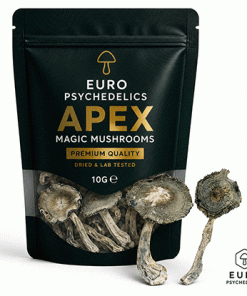
A+ Magic Mushrooms: Origins, Taxonomy, Characteristics & European Legal Context
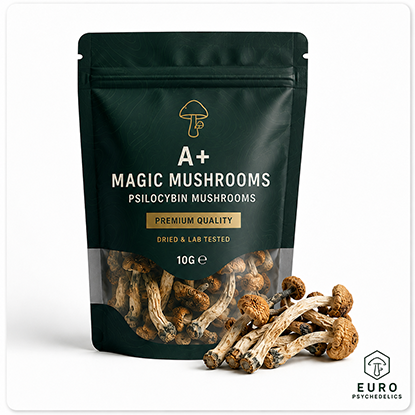
A+ Magic Mushrooms is a name commonly encountered in contemporary mushroom culture for a Psilocybe cubensis-associated variety or lineage. Unlike the scientific species name Psilocybe cubensis, “A+” is an informal designation rather than a recognised taxonomic rank. This distinction is important because modern mushroom communities use a wide range of names to describe cultivated lineages, phenotypes and selections.
From a scientific perspective, Psilocybe cubensis is a recognised species of basidiomycete fungus. NCBI lists Psilocybe cubensis as a species within the genus Psilocybe, while PubChem likewise records it as a recognised species with taxonomy ID 181762.
The precise history behind the A+ designation is less firmly documented in scientific literature than the taxonomy of P. cubensis itself. Therefore, descriptions of A+ are best treated as information about an informal mushroom lineage or variety rather than evidence of a separate species.
A+ Magic Mushrooms: Characteristics and Taxonomy
The term A+ Magic Mushrooms is primarily a community and cultivation-related name. It does not represent a separate scientific species in the way that Psilocybe cubensis does.
This difference between scientific taxonomy and informal variety names is common in cultivated fungi. A scientific name identifies an organism within a biological classification system, whereas a variety or lineage name can reflect selection, appearance, cultivation history or community convention.
For A+, the scientifically cautious description is therefore an association with Psilocybe cubensis, rather than claiming that A+ constitutes a distinct species.
Scientific Classification
The broader classification of Psilocybe cubensis is:
- Kingdom: Fungi
- Phylum: Basidiomycota
- Class: Agaricomycetes
- Order: Agaricales
- Genus: Psilocybe
- Species: Psilocybe cubensis
NCBI identifies Psilocybe cubensis as a basidiomycete fungus and records Stropharia cubensis as its historical basionym.
The genus Psilocybe itself contains numerous species, meaning that the word “magic mushroom” should not be treated as a scientific classification. Different species can have different geographic distributions, appearances and chemical profiles.
What Does the A+ Name Mean?
The “A+” designation is generally encountered as an informal name within modern Psilocybe cubensis culture.
Unlike names such as Psilocybe cubensis, which can be traced through formal taxonomic databases, A+ does not have an equivalent formal taxonomic status.
This means that claims about its precise original breeder, geographic discovery or genetic ancestry should be treated carefully unless supported by primary documentation.
Online mushroom culture contains many lineage histories that are repeated across websites and forums. Repetition, however, does not necessarily establish scientific provenance.
For an educational product page, it is therefore more accurate to say that A+ is a community-recognised variety or lineage name associated with P. cubensis rather than assigning it an unsupported geographic origin.
Appearance and Morphological Characteristics
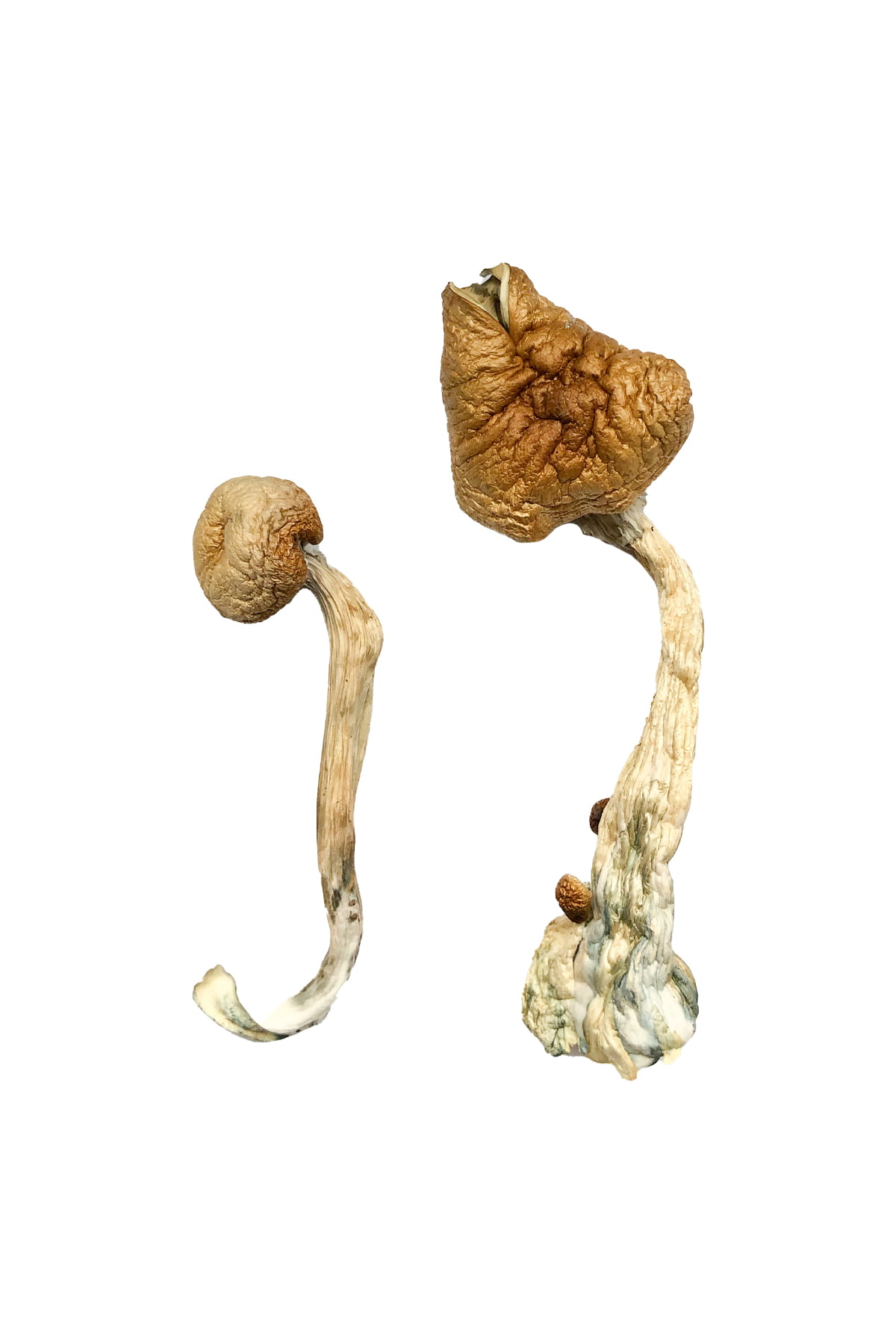
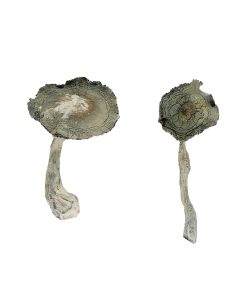
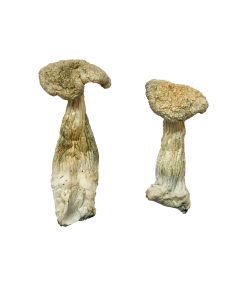
Descriptions of A+ mushrooms generally concern their visible morphology rather than a unique scientific characteristic.
Like other Psilocybe cubensis-associated material, individual specimens can vary in:
- cap colour
- cap shape
- stem proportions
- surface texture
- maturity
- overall fruiting-body structure
These characteristics are influenced by genetics and environmental conditions, meaning that appearance alone cannot reliably establish whether an individual specimen belongs to a particular named lineage.
This is one reason scientific mushroom identification requires more than comparing photographs with an online description.
A variety name can provide useful cultural context, but it should not be treated as a substitute for formal identification.
A+ and Psilocybe cubensis
The connection between A+ and Psilocybe cubensis is particularly important for understanding the name.
Psilocybe cubensis is one of the best-known species associated with psilocybin-containing mushrooms and is extensively represented in contemporary mushroom culture. NCBI and PubChem both recognise it as a distinct fungal species.
At the same time, the species contains a broad range of cultivated and community-recognised names.
These names should not automatically be interpreted as formal biological subdivisions.
For example, describing something as an “A+ variety” does not mean that it has been scientifically classified as a subspecies or separate species.
Species Versus Variety
The distinction can be simplified:
Species: a formal biological classification such as Psilocybe cubensis.
Lineage: a term that can describe ancestry or a particular genetic history.
Cultivar/variety name: a name used to distinguish a cultivated form or selection.
Community name: an informal designation that may develop through online or cultivation communities.
A+ belongs most appropriately to the latter categories rather than being presented as a separate scientific species.
Psilocybin-Containing Fungi
Some members of the Psilocybe genus contain the naturally occurring compounds psilocybin and psilocin.
The European Union Drugs Agency describes hallucinogenic mushrooms as psychoactive fungi containing hallucinogenic compounds, most commonly psilocybin and psilocin.
Psilocybin is converted by the body into psilocin, which is associated with the characteristic psychoactive effects of psilocybin-containing mushrooms.
The presence and concentration of naturally occurring compounds can vary between specimens. Consequently, a variety name such as A+ should not be treated as a laboratory measurement or a guarantee of a particular chemical composition.
That distinction is especially important when information is presented online.
Why Mushroom Names Can Be Misleading
The terminology surrounding psychedelic mushrooms has developed through several overlapping traditions.
Scientific mycology uses formal taxonomic systems. Cultivation communities use lineage and variety names. Online retailers may use additional product names. Historical literature may use older scientific classifications.
These systems can overlap without being identical.
As a result, two websites may use the same variety name while providing different descriptions of its ancestry.
The safest approach is to separate what is scientifically established from what is community terminology.
For A+, the strongest scientific statement concerns the underlying Psilocybe cubensis association. The exact origin story of the A+ name should be treated more cautiously unless supported by documented historical or genetic evidence.
Geographic Origins and Provenance
Unlike geographically named varieties, the A+ name does not itself provide a reliable indication of where a mushroom originated.
This is an important difference from names that explicitly refer to places such as Amazonian, Cambodian, Burmese or Costa Rican varieties.
A name can become geographically associated with a mushroom through cultivation history without demonstrating that the species originated there.
Consequently, an educational description of A+ should avoid presenting an unsupported country of origin as established fact.
The broader species Psilocybe cubensis has a well-documented presence in tropical and subtropical environments, but that does not establish a specific geographic origin for every modern named lineage.
A+ in Contemporary Mushroom Culture
A+ belongs to a much larger vocabulary of names used in modern mushroom culture.
Over time, cultivated P. cubensis material has been given numerous descriptive names. These names can reflect:
- morphology
- historical associations
- geographical references
- cultivation selections
- personal naming conventions
- community traditions
Some names become widely recognised even though they have no formal standing in scientific taxonomy.
This is not unusual in cultivated organisms. Similar naming patterns can be found in horticulture, ornamental plants and domesticated fungi.
The difference is that online mushroom terminology can spread rapidly, making it difficult to determine where a particular name originated.
Scientific Identification Versus Internet Naming
A photograph labelled “A+” does not by itself establish that the specimen belongs to a particular genetic lineage.
Scientific identification can involve morphology, microscopy, molecular methods and comparison with reference material. Even these methods may answer different questions depending on the investigation.
A consumer-facing variety name therefore provides a useful descriptive label but should not be presented as equivalent to laboratory-confirmed genetic identification.
This distinction helps prevent exaggerated claims about individual mushroom varieties.
Dried Mushroom Terminology
The word dried describes the physical condition of fungal material rather than its taxonomy.
Drying does not create a new species or change the formal scientific name of the organism from which the material originated.
For an educational description, it is useful to keep three concepts separate:
- Scientific identity — for example, Psilocybe cubensis.
- Informal lineage name — for example, A+.
- Physical condition — for example, dried material.
Keeping these categories separate makes mushroom descriptions clearer and scientifically more accurate.
Psilocybin Research
Scientific research into psilocybin has expanded considerably in recent years.
Researchers have investigated psilocybin and related compounds in controlled clinical settings, including research concerning depression and other psychiatric conditions.
However, research findings should not be confused with regulatory approval.
The EUDA reported that, as of its 2024 overview, no classical psychedelic had been approved at EU or Member State level for medical treatment of neuropsychiatric disorders. Psilocybin has nevertheless progressed through clinical research, including Phase 2 studies for treatment-resistant depression.
This distinction is important when writing about psychedelic mushrooms.
A mushroom containing a compound under clinical investigation should not automatically be described as a medicine or medical treatment.
European Legal Context
The legal position of psilocybin-containing mushrooms varies substantially across Europe.
Psilocybin and psilocin are controlled under the 1971 United Nations Convention on Psychotropic Substances. However, individual European countries implement drug-control legislation differently.
The EUDA notes that some European jurisdictions specifically regulate hallucinogenic mushrooms, while others approach the issue through legislation concerning psilocybin or psilocin. It also describes differences involving fresh versus prepared material and the interpretation of cultivation, possession and supply laws.
Therefore, there is no single legal status that can accurately be applied to A+ mushrooms throughout Europe.
For European readers, the appropriate approach is to check the current legislation of the specific country concerned and, where necessary, obtain advice from an appropriate legal or governmental authority.
Why European Laws Differ
Drug legislation is established at national level, even where countries share international treaty obligations.
This creates considerable variation in how individual countries treat:
- psilocybin
- psilocin
- fungi containing controlled substances
- fresh mushrooms
- dried mushrooms
- spores
- cultivation
- possession
- preparation
- supply
The EUDA’s current European reporting continues to identify hallucinogenic mushrooms as part of the broader European drug landscape.
A website aimed at European readers should therefore avoid blanket statements such as “legal in Europe” or “illegal everywhere in Europe.”
Responsible Interpretation of A+ Magic Mushrooms
The most scientifically responsible way to describe A+ Magic Mushrooms is as an informal name associated with Psilocybe cubensis within contemporary mushroom culture.
The name itself does not establish:
- a separate species
- a scientifically recognised subspecies
- a guaranteed genetic profile
- a fixed chemical composition
- a particular geographic origin
Those distinctions allow readers to understand the subject without confusing community terminology with formal mycology.
The underlying species, Psilocybe cubensis, has a recognised scientific classification, while A+ represents the type of informal naming commonly encountered around cultivated mushroom lineages.
Frequently Asked Questions
1. What are A+ Magic Mushrooms?
A+ Magic Mushrooms is an informal name used in contemporary mushroom culture for material associated with the Psilocybe cubensis group. A+ is better understood as a variety or lineage-style designation rather than a separate scientific species.
2. Is A+ a separate species of mushroom?
No. A+ should not be presented as a separate scientific species. Psilocybe cubensis is the recognised species commonly associated with this type of naming, while A+ is an informal designation.
3. What is Psilocybe cubensis?
Psilocybe cubensis is a recognised species of basidiomycete fungus in the genus Psilocybe. NCBI lists it as species-level taxon 181762.
4. Does the A+ name prove a mushroom’s genetics?
No. A variety name alone does not constitute genetic testing. Different specimens carrying the same informal name may not necessarily have identical genetic histories.
5. What compounds are associated with hallucinogenic mushrooms?
The compounds most commonly associated with hallucinogenic mushrooms are psilocybin and psilocin. The EUDA identifies these as the principal compounds associated with this group of psychoactive fungi.
6. Are A+ Magic Mushrooms legal throughout Europe?
No single European rule applies everywhere. The legal treatment of psilocybin-containing mushrooms differs between national jurisdictions, including differences concerning possession, cultivation, preparation and supply. Current national legislation should be checked for the relevant country.
| Quantity | 7grams, 14grams, 28grams |
|---|
Be the first to review “A+ Magic Mushrooms”
Related products
Magic Mushrooms
Magic Mushrooms
Magic Mushrooms
Magic Mushrooms
Magic Mushrooms
Magic Mushrooms
Magic Mushrooms
Magic Mushrooms
Reviews
There are no reviews yet.