Psychedelic Research
Psilocybin Research in Europe: Clinical Trials, Scientific Evidence & Future Developments
Nov
Psilocybin Research in Europe: Clinical Trials, Scientific Evidence & Future Developments
Published: November 2026 | Category: Psychedelic Research
Introduction
Psilocybin research has become an important area of modern neuroscience and mental health research. Across Europe, universities, hospitals and independent research institutions are investigating how this naturally occurring psychedelic compound interacts with the brain and whether it could have a role in treating certain mental health conditions.
Interest has grown considerably, particularly in relation to treatment-resistant depression, psychological support and the relationship between brain activity and consciousness.
But what does the latest scientific evidence actually show? Which European countries are conducting research? And how close are we to seeing psilocybin-based medicines become part of mainstream healthcare?
Let’s explore the research, the clinical trials and the regulatory developments shaping this evolving field.
1. Why are scientists researching psilocybin?
Psilocybin is a naturally occurring psychedelic compound found in certain mushroom species. After ingestion, the body converts it into psilocin, which interacts primarily with serotonin receptors, including the 5-HT2A receptor.
Serotonin is a neurotransmitter involved in several processes, including mood regulation, perception, cognition and emotional processing.
Researchers are particularly interested in how psilocybin temporarily changes communication between different brain networks.
Scientific investigations have explored:
- Changes in brain connectivity.
- Emotional processing and perception.
- Cognitive flexibility.
- Psychological responses to controlled psychedelic experiences.
- Potential applications in treatment-resistant mental health conditions.
Importantly, these mechanisms are still being investigated. A biological effect does not automatically translate into a safe or effective medical treatment.
2. What is happening in European clinical trials?
Europe has become an important location for regulated psychedelic research.
The European Medicines Agency’s Clinical Trials Information System (CTIS) allows researchers, healthcare professionals and members of the public to examine registered clinical studies.
Several interesting developments are visible in the November 2026 trial records.
Denmark: Research into depression and psychological support
The Psilocybin Setting Trial (PSISET), registered under EU trial number 2025-522961-31-01, is investigating the effects of different levels of psychological support during psilocybin treatment for depression.
The study aims to compare psilocybin combined with psychotherapy against psilocybin with basic support and standard care.
The trial was authorised in July 2026, with recruitment pending in the latest available record.
This research is particularly interesting because it examines not only the substance itself but also the importance of the therapeutic environment.
Spain: Investigating brain activity
A Spanish Phase II clinical trial, registered as 2025-521690-14-00, is examining the relationship between psilocybin, brain connectivity and the psychedelic experience in people with major depressive disorder.
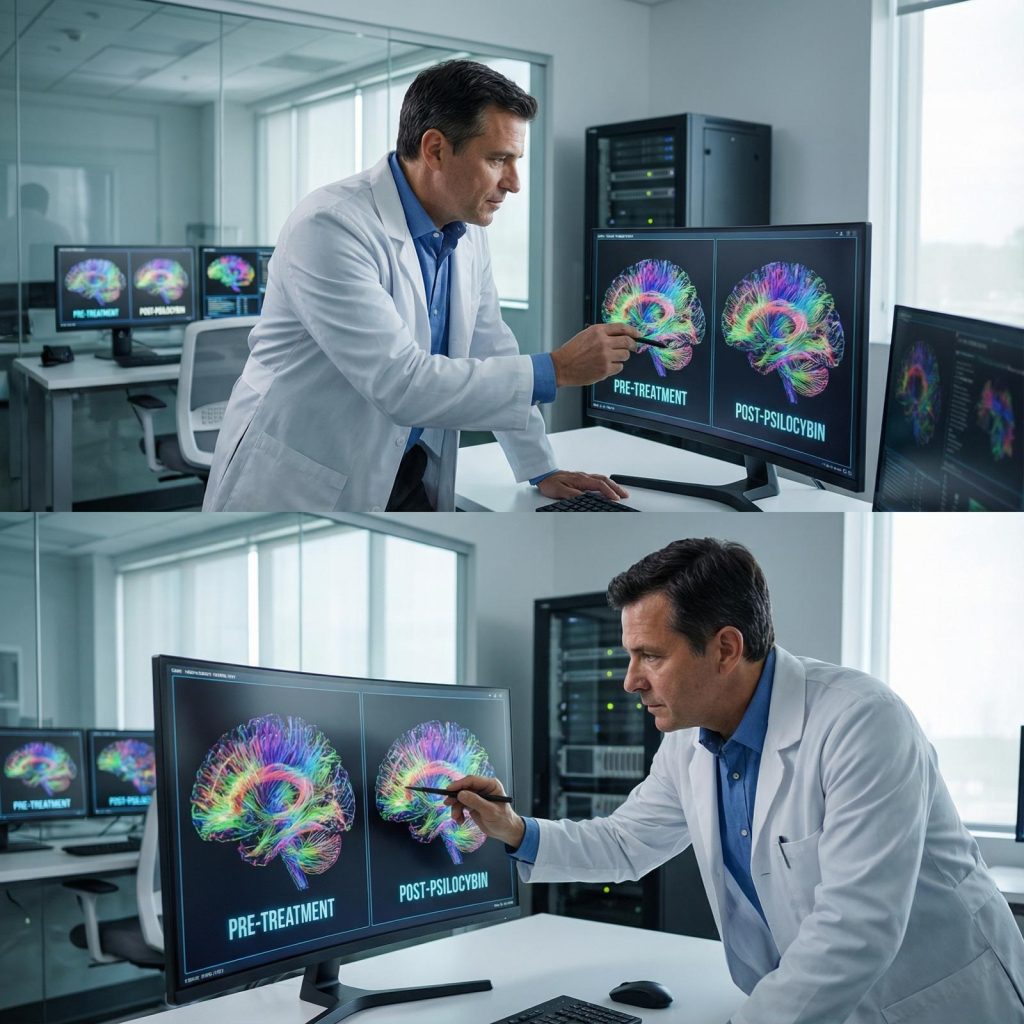
Researchers are using functional magnetic resonance imaging (fMRI) to investigate changes in resting-state brain networks.
The study compares psilocybin combined with pimavanserin against psilocybin combined with placebo.
Its objective is to understand which changes in brain connectivity are associated with the psychedelic experience.
Sweden: Research involving cancer-related depression
The CAPSI study, registered as 2023-505532-35-00, is investigating psilocybin in people experiencing major depression alongside cancer.
The Phase II study examines the effects of a single 25 mg dose compared with an active placebo, alongside a controlled research protocol.
The trial experienced a temporary halt in 2026 and subsequently restarted. Its status should therefore be checked in the official register rather than assumed from its original schedule.
France: A Phase III research programme
One particularly notable development is the ERPPAD trial, registered as 2025-525069-65-00.
This Phase III study is investigating psilocybin in people with alcohol use disorder and depressive symptoms.
The research compares two treatment approaches involving different psilocybin doses and examines the incidence of relapse following detoxification.
The trial began in France in June 2026 and was listed as recruiting in the November 2026 register.
It is an important example of how clinical investigation is extending beyond depression alone.
These examples demonstrate the diversity of current research. They do not establish that psilocybin is an approved treatment for any of these conditions.
3. What did recent UK research discover?
Although the United Kingdom is no longer part of the European Union, its research remains relevant to the wider European scientific landscape.
In August 2026, researchers published findings from the PsiDeR study in Nature Medicine.
This publicly funded randomised controlled feasibility trial investigated psilocybin-assisted therapy for treatment-resistant depression in an NHS setting.
The study recruited 60 participants. Half received a 25 mg dose of psilocybin, while the comparison group received a placebo. Both groups received psychological support.
The researchers reported significant improvements in depressive symptoms in the psilocybin group compared with placebo.
However, this was a relatively small feasibility study with six weeks of follow-up. Larger studies and longer-term research are necessary before drawing conclusions about long-term effectiveness and safety.
This is precisely why controlled clinical research matters: promising early results need to be tested and independently evaluated.
4. Is psilocybin approved for medical use in Europe?
This is one of the most important distinctions to understand.
Clinical research and medical authorisation are two different things.
A substance can demonstrate promising results in clinical studies without being approved as a medicine.
As of November 2026, psilocybin does not have an EU-wide marketing authorisation as a medicine.
The European Medicines Agency evaluates medicinal products through a separate regulatory process involving evidence of quality, safety and efficacy.
There may also be specific national legal frameworks and exceptional medical arrangements, but these do not create general permission to use or supply psilocybin.
Anyone researching this subject should distinguish between:
- Registered clinical trials.
- Experimental medical treatments.
- National exceptional-access arrangements.
- Fully authorised medicines.
- Non-medical possession and supply under national drug laws.
The legal position can differ substantially between European countries.
5. What are the main scientific challenges?
Despite growing interest, important scientific questions remain unanswered.
Long-term safety
Researchers need more information about the long-term effects of treatment and which individuals may face increased risks.
Individual differences
People can respond differently to psychedelic substances. Medical history, psychological characteristics and environmental factors may influence outcomes.
The importance of psychological support
Researchers are investigating how preparation, professional supervision and psychological support contribute to treatment outcomes.
Study size and reproducibility
Some studies involve relatively small participant groups. Larger, well-controlled studies are needed to establish whether initial findings can be reproduced.
Access and regulation
Even if a medicine eventually receives approval, questions about cost, reimbursement, specialist training and healthcare access will remain.
6. What could the future of psilocybin research look like?
The next phase of research will likely focus on larger clinical studies, longer follow-up periods and better understanding of how psychedelic experiences interact with psychological support.
Researchers will also need to establish which patient groups might benefit, which individuals should avoid these treatments and how potential risks can be managed.
The European research environment provides an opportunity to examine these questions through regulated clinical trials and collaboration between universities, hospitals and scientific institutions.
However, scientific progress should not be confused with commercial availability or regulatory approval.
Frequently Asked Questions
Is psilocybin being researched in Europe?
Yes. Clinical studies are investigating its potential effects in conditions including depression, alcohol use disorder and other mental health conditions.
Which European countries are conducting psilocybin research?
Recent registered studies include research in Denmark, Spain, Sweden, France, Belgium and the Netherlands, among others.
Has psilocybin been approved as a medicine in the European Union?
No EU-wide marketing authorisation for a psilocybin medicine had been granted as of November 2026.
Does clinical trial registration mean a treatment works?
No. Registration means a study has been entered into a regulatory trial system. It does not establish that the treatment is effective or safe.
Is psilocybin research the same as recreational use?
No. Clinical research takes place under controlled protocols, with defined eligibility criteria, medical oversight and ethical safeguards. Recreational use does not provide the same conditions or protections.
Conclusion: Science before speculation
Psilocybin research in Europe is moving into an increasingly interesting phase. New clinical studies are examining depression, brain connectivity, psychological support and other potential medical applications.
The findings so far justify continued scientific investigation, but they should be interpreted carefully.
The future of psychedelic science will depend on rigorous clinical evidence, responsible regulation and a clear understanding of both potential benefits and risks.
At Euro Psychedelics, we believe that informed discussion starts with credible research, scientific transparency and a responsible approach to botanical and psychedelic education.
Disclaimer: This article is for educational and informational purposes only. It is not medical advice and does not recommend the use, purchase or supply of controlled substances. Psilocybin remains subject to applicable national laws. Experimental research should not be interpreted as an endorsement of unsupervised use.
