
African Transkei Magic Mushrooms: Origins, Taxonomy, Characteristics & European Legal Context
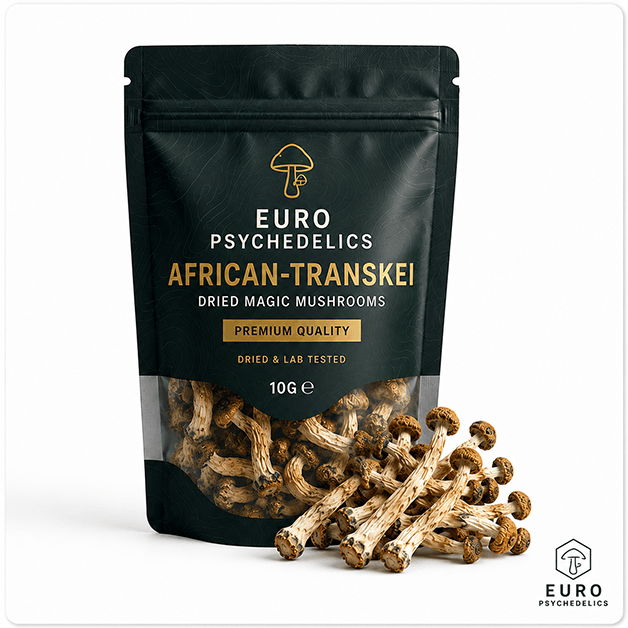
African Transkei Magic Mushrooms is a name associated with a South African Psilocybe cubensis lineage commonly referred to as Transkei, South African Transkei or Transkei Cubensis. The name connects the lineage with the former Transkei region of South Africa, now largely incorporated into the Eastern Cape. Historical mycological and ethnomycological sources describe a South African Transkei strain of Psilocybe cubensis, while contemporary references commonly treat Transkei as a cultivated lineage rather than a separate species.
The distinction between a scientific species and a cultivated lineage name is important. Psilocybe cubensis is a formally recognised species, whereas “African Transkei” is a geographic and cultural designation used to distinguish a particular lineage associated with South Africa. NCBI lists Psilocybe cubensis as a species within the genus Psilocybe.
Because informal mushroom names can develop through cultivation communities and historical collections, claims about ancestry or characteristics should be separated from established scientific taxonomy.
African Transkei Magic Mushrooms: Origins and Taxonomy
The African Transkei Magic Mushrooms name is closely connected with the Transkei region of southern Africa. Transkei was a former territory in southeastern South Africa and is now part of the Eastern Cape province.
Historical ethnomycological literature identifies a South African Transkei strain of Psilocybe cubensis. One published ethnomycological source describes the Transkei strain as a rare South African strain of P. cubensis, while another documents imagery and discussion of a “South African Transkei” form of the species.
This gives the name a more geographically grounded history than many modern mushroom labels. Nevertheless, the word “Transkei” should not be mistaken for a scientific species designation.
Scientific Classification
The underlying species is generally described as:
- Kingdom: Fungi
- Phylum: Basidiomycota
- Class: Agaricomycetes
- Order: Agaricales
- Genus: Psilocybe
- Species: Psilocybe cubensis
- Common lineage name: African Transkei / South African Transkei
NCBI currently recognises Psilocybe cubensis at species level and records Stropharia cubensis as its historical basionym.
This means that African Transkei is best understood as a geographically associated lineage or variety name within Psilocybe cubensis rather than a separate species.
The Geographic Meaning of “Transkei”
The Transkei name has a genuine geographic connection to South Africa.
The former Transkei territory occupied an area along the country’s southeastern coastline and became incorporated into the Eastern Cape following the end of apartheid-era territorial administration.
For mushroom nomenclature, this geographic association is significant because a number of Psilocybe cubensis lineages have historically acquired names based on where material was collected or where particular populations were documented.
Ethnomycological literature has specifically associated the South African Transkei strain with P. cubensis. One source discussing historical mushroom varieties describes Transkei among P. cubensis varieties whose names reflect geographical discovery or collection.
The geographic name therefore provides useful historical context, although it does not mean that every mushroom currently sold or described under the Transkei name can be genetically traced directly to a wild South African population.
Historical Documentation of the Transkei Lineage
Transkei has an unusually interesting place in the history of modern Psilocybe cubensis varieties.
An ethnomycological publication describes a rare South African Psilocybe cubensis strain known as the Transkei strain and places it within the historical development of cultivated mushroom varieties.
Another ethnomycological publication includes an image caption identifying a “Wavy Capped South African Transkei Strain” and discusses the broader distribution of P. cubensis in subtropical environments.
These historical records are useful because they show that the Transkei name was not simply invented as a modern marketing label. It has appeared in mycological and ethnomycological literature associated with a South African form of P. cubensis.
At the same time, historical documentation does not necessarily establish that all later specimens carrying the Transkei name are genetically identical.
Morphology and Appearance
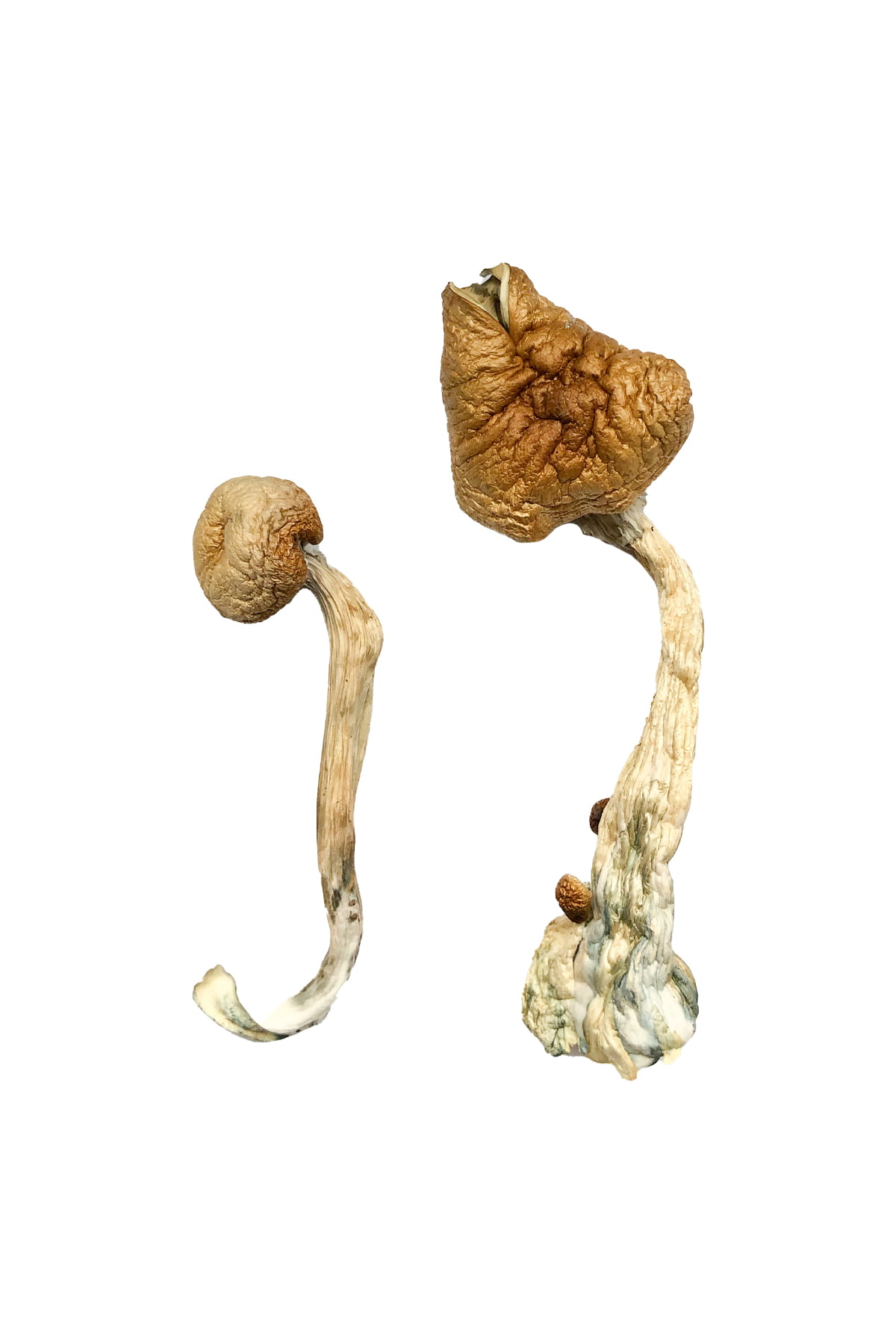
Descriptions of Transkei-associated Psilocybe cubensis specimens generally place them within the familiar morphological range of the species.
Individual mushrooms can vary in:
- cap colour
- cap shape
- stem thickness
- stem length
- surface texture
- overall size
- maturity
Historical imagery and descriptions have used terms such as “wavy capped” when discussing South African Transkei material.
However, morphology alone is not enough to establish genetic identity.
Fungi can exhibit considerable variation depending on genetics, environmental conditions and developmental stage. A specimen’s appearance can therefore provide descriptive information without functioning as definitive proof of lineage.
This is especially important when comparing named P. cubensis varieties. A visually distinctive mushroom does not necessarily represent a separate taxonomic group.
African Transkei and Psilocybe cubensis
The relationship between African Transkei and Psilocybe cubensis is central to understanding the name.
Psilocybe cubensis is formally recognised as a species by major taxonomic resources. NCBI assigns it Taxonomy ID 181762 and lists it within the fungal order Agaricales.
Transkei, by contrast, is a lineage-style name.
This distinction is similar to the way geographical names are used throughout cultivated mushroom culture. Names can describe a particular population, historical collection or cultivated lineage without changing the scientific species.
The term African Transkei therefore communicates additional historical information about the lineage while Psilocybe cubensis communicates its scientific classification.
Species, Lineage and Variety: What Is the Difference?
Mushroom terminology can become confusing because several different concepts are often placed next to one another.
Species
A species is a formal scientific taxonomic category. Psilocybe cubensis is an example.
Lineage
A lineage describes ancestry or a particular genetic history. In mushroom culture, lineage names can persist even when formal genetic documentation is limited.
Variety or Cultivar
These terms can be used informally to distinguish cultivated forms within a species.
Geographic Name
A geographic designation can indicate where a specimen or lineage was historically collected or associated.
African Transkei combines several of these ideas: it is a geographic name associated with a recognised Psilocybe species and a cultivated lineage.
Why Geographic Mushroom Names Matter
Geographical naming is widespread in mycology.
Names such as Amazonian, Cambodian, Burmese, Mexican and Transkei can reflect the history of specimen collection or the communities that preserved particular lineages.
However, geographical labels should not be interpreted too literally.
A mushroom labelled with a country’s name does not necessarily represent every wild population of that species in that country. Nor does the name necessarily mean that the present-day material was recently collected there.
Instead, the name may preserve a historical association with an original collection or lineage.
This is particularly relevant to African Transkei because the Transkei region itself has undergone major political and administrative changes since the original terminology became established.
Fungal Biodiversity in Southern Africa
Southern Africa contains substantial fungal biodiversity, although the distribution of individual Psilocybe species varies considerably.
The presence of a P. cubensis-associated lineage in South Africa is particularly interesting in the context of the species’ broad subtropical distribution.
Historical mycological literature describes P. cubensis as having a widespread distribution in subtropical regions and associates the species with dung and manured soils in suitable environments.
This ecological context helps explain why geographic strains have historically attracted scientific and amateur mycological interest.
It also demonstrates why a geographic mushroom name should not automatically be interpreted as a completely separate species.
Psilocybin and Psilocin
Some Psilocybe species contain the naturally occurring compounds psilocybin and psilocin.
The European Union Drugs Agency identifies psilocybin as the main psychoactive compound associated with hallucinogenic mushrooms and explains that psilocybin is converted into pharmacologically active psilocin.
The chemistry of individual specimens can vary, however. A lineage name such as Transkei should not be treated as a laboratory measurement.
Claims about a particular variety having a fixed chemical concentration or guaranteed pharmacological profile should therefore be treated cautiously unless supported by analytical testing.
This is another reason to distinguish taxonomy, lineage terminology and chemical analysis.
African Transkei in Modern Mushroom Culture
The Transkei name has remained part of contemporary Psilocybe cubensis culture.
Modern mushroom communities use numerous geographic and lineage names to distinguish different forms of the species. Contemporary strain guides commonly describe South African Transkei as a P. cubensis variety and use alternative names including Transkei Cubensis and South African Cubensis.
The continued use of the name reflects the enduring interest in geographically associated fungal lineages.
At the same time, modern online descriptions sometimes repeat claims about morphology, potency or origins without providing primary evidence.
For accurate educational content, documented history should therefore be separated from anecdotal descriptions.
Why Potency Claims Should Be Treated Carefully
One of the most common problems with online mushroom descriptions is the presentation of variety names as if they guarantee a particular chemical strength.
That is not scientifically reliable.
Psilocybin and psilocin concentrations can vary between individual mushrooms and samples. Genetics, environmental conditions and other biological factors can contribute to variation.
Consequently, a variety label cannot substitute for chemical analysis.
For African Transkei, the useful scientific description is its association with Psilocybe cubensis and its South African geographic history—not an unsupported numerical claim about chemical content.
Dried Mushroom Terminology
When the word dried appears alongside a mushroom name, it describes the physical condition of the fungal material rather than its taxonomic identity.
Dried Psilocybe cubensis remains material originating from P. cubensis. Drying does not create a new species or transform one lineage into another.
The distinction can therefore be expressed simply:
African Transkei — lineage/geographic name.
Psilocybe cubensis — scientific species.
Dried — physical state.
Keeping these concepts separate makes product and educational descriptions much clearer.
Scientific Research and Psychedelic Mushrooms
Interest in psilocybin research has increased substantially over the last several years.
Researchers have investigated psychedelic compounds in controlled clinical settings, including studies involving depression and other psychiatric conditions.
However, scientific research should not be confused with medical approval.
The EUDA notes that, as of its therapeutic-use overview, classical psychedelics had not received EU or Member State regulatory approval for medical treatment of neuropsychiatric disorders. Psilocybin has nevertheless progressed through clinical research, including Phase 2 studies for treatment-resistant depression.
This distinction is particularly important for websites discussing psychedelic mushrooms.
Research into a compound does not mean that a particular mushroom variety is an approved medicine.
European Legal Context
The legal status of psilocybin-containing mushrooms differs significantly across Europe.
Psilocybin and psilocin are controlled under the 1971 United Nations Convention on Psychotropic Substances. However, European countries have implemented these international obligations in different ways.
According to the EUDA, some European jurisdictions specifically list hallucinogenic mushrooms as controlled substances, while others regulate the relevant compounds. Some legal systems also distinguish between different forms or circumstances.
As a result, there is no single European legal status that can accurately be applied to African Transkei mushrooms.
National legislation may address issues such as possession, cultivation, preparation and supply differently.
For European readers, the appropriate approach is to consult the current legislation and competent authority in the specific country concerned.
Why Country-Specific Research Matters
A statement that something is “legal in Europe” can be misleading.
Europe contains multiple independent legal jurisdictions, each with its own controlled-substance framework.
The EUDA specifically advises that laws differ between Member States and can change over time, making current national sources important when determining legal status.
This is especially relevant to dried mushroom material because national legislation may distinguish between fresh, dried, prepared or otherwise processed forms.
Responsible Interpretation of African Transkei
The most scientifically responsible description of African Transkei Magic Mushrooms is that the name refers to a South African-associated lineage of Psilocybe cubensis.
Its importance comes from the combination of:
- a recognised fungal species,
- a South African geographic association,
- historical ethnomycological documentation,
- and a continuing role in modern mushroom culture.
The name should not, however, be presented as a separate scientific species.
Similarly, claims about exact genetics, chemical content or universal characteristics should not be inferred solely from the Transkei label.
The distinction between established taxonomy and informal lineage terminology makes the subject both more accurate and more useful for readers interested in mycology.
Frequently Asked Questions
1. What are African Transkei Magic Mushrooms?
African Transkei Magic Mushrooms is a name associated with a South African lineage of Psilocybe cubensis. Historical and contemporary sources refer to the lineage as Transkei, South African Transkei or Transkei Cubensis.
2. Where does the Transkei name come from?
The name refers to the former Transkei region of southeastern South Africa, now largely incorporated into the Eastern Cape. The geographic association forms an important part of the lineage’s historical identity.
3. Are African Transkei mushrooms a separate species?
No. African Transkei is generally described as a lineage or variety associated with Psilocybe cubensis. NCBI recognises P. cubensis as the species-level taxon.
4. What is Psilocybe cubensis?
Psilocybe cubensis is a formally recognised fungal species in the genus Psilocybe. NCBI assigns it Taxonomy ID 181762 and records Stropharia cubensis as its historical basionym.
5. What compounds are associated with hallucinogenic mushrooms?
Psilocybin and psilocin are the principal compounds associated with hallucinogenic mushrooms. The EUDA explains that psilocybin is converted into the pharmacologically active compound psilocin.
6. Is African Transkei legal throughout Europe?
No. The legal status of psilocybin-containing mushrooms varies between European countries. Psilocybin and psilocin are internationally controlled, while national legislation determines how mushroom material is treated within individual jurisdictions.
| Quantity | 7grams, 14grams, 28grams |
|---|
Be the first to review “African Transkei Magic Mushrooms”
Related products
Magic Mushrooms

Magic Mushrooms
Magic Mushrooms
Magic Mushrooms
Magic Mushrooms
Magic Mushrooms
Magic Mushrooms
Magic Mushrooms
Reviews
There are no reviews yet.