
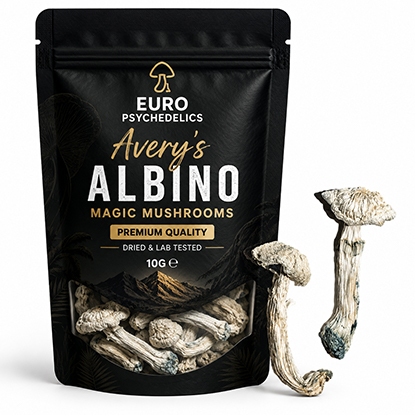
Avery’s Albino Magic Mushrooms
€75 – €350Price range: €75 through €350
Avery’s Albino Magic Mushrooms: Origins, Characteristics, Taxonomy & European Legal Context
Avery’s Albino Magic Mushrooms is a well-known name within modern psychedelic mushroom culture. The name is generally associated with an albino or very pale lineage of Psilocybe cubensis rather than a separate scientifically recognised species.
The term is particularly interesting from a mycological perspective because it illustrates the difference between species-level taxonomy and informal lineage names. “Avery’s Albino” describes a particular lineage or phenotype used in mushroom communities, while Psilocybe cubensis is the formal scientific species designation.
What Are Avery’s Albino Magic Mushrooms?
Avery’s Albino is commonly described as a pale or albino-associated Psilocybe cubensis lineage. The name is used primarily within mushroom culture and does not constitute a separate scientific species.
The term albino is also used somewhat loosely in mushroom communities. In biological terminology, true albinism involves the absence or substantial reduction of pigmentation. Mushroom lineages described as albino may instead exhibit leucistic characteristics, where pigmentation is reduced rather than completely absent.
This distinction explains why names such as “Albino,” “Leucistic,” and “Avery’s Albino” can sometimes be used inconsistently.
Taxonomy of Avery’s Albino
Where Avery’s Albino refers to the commonly described Psilocybe cubensis lineage, its underlying species classification is:
- Kingdom: Fungi
- Phylum: Basidiomycota
- Class: Agaricomycetes
- Order: Agaricales
- Genus: Psilocybe
- Species: Psilocybe cubensis
Psilocybe cubensis is a formally recognised fungal species.
Avery’s Albino, by contrast, is an informal lineage or variety name. It should therefore not be written as though “Avery’s Albino” were a separate scientific species.
The Meaning of “Albino”
The word “albino” refers to reduced or absent pigmentation.
In mushroom terminology, however, the situation is more complicated than it is in animals.
Some mushroom lineages have mutations affecting pigment production, producing fruiting bodies that appear exceptionally pale. Community terminology may describe these as albino even when the biological mechanism is more accurately characterised as leucism or another pigmentation variation.
Consequently, appearance and scientific terminology are not always perfectly aligned.
This is an important distinction when discussing named mushroom varieties because a striking visual characteristic does not necessarily represent a new species.
Avery’s Albino and Leucism
Leucism is a condition involving reduced pigmentation.
A leucistic mushroom may retain some pigmentation in particular tissues while appearing substantially lighter overall.
This differs from complete absence of pigment.
The terminology surrounding albino and leucistic mushroom varieties is therefore best understood as descriptive rather than as a formal taxonomic category.
For Avery’s Albino, the name primarily communicates its characteristic pale appearance within mushroom culture.
Appearance and Morphology
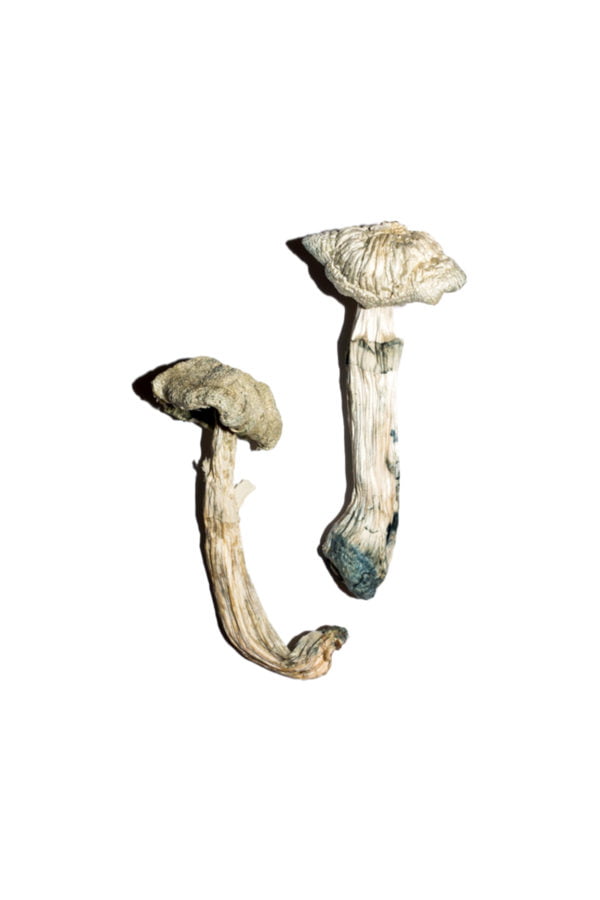
Avery’s Albino is generally associated with a noticeably pale appearance.
Descriptions commonly focus on:
- light or pale caps;
- pale stems;
- reduced pigmentation;
- characteristic Psilocybe cubensis morphology;
- darker spore deposits despite the pale appearance of the mushroom itself.
The contrast between pale mushroom tissue and dark spores is particularly interesting from a biological perspective.
Individual specimens can still vary substantially in size, shape and appearance. Environmental conditions, maturity and genetics can all influence morphology.
Therefore, the appearance of a mushroom labelled Avery’s Albino should not by itself be regarded as proof of genetic identity.
Why the Spore Colour Can Be Different
One of the interesting characteristics associated with Psilocybe cubensis is that a pale mushroom can still produce dark spores.
The mushroom’s visible tissues and its reproductive spores are biologically distinct structures.
Consequently, reduced pigmentation in the fruiting body does not necessarily mean that every structure associated with the fungus will appear white or colourless.
This is one reason why the visual appearance of an albino-associated mushroom can be particularly striking.
Lineage Versus Species
Understanding the difference between lineage and species is essential.
A species is a formal taxonomic category used by scientists to classify organisms.
A lineage is a group of organisms sharing particular genetic ancestry or characteristics.
An informal mushroom name can refer to a lineage without having independent taxonomic status.
Avery’s Albino is therefore better understood as a named lineage within the broader world of Psilocybe cubensis rather than a species of its own.
The Importance of Scientific Names
Scientific names provide a common language for researchers around the world.
The name Psilocybe cubensis allows scientists to refer to a particular species without relying on potentially ambiguous common names.
Names such as:
- Avery’s Albino;
- Blue Meanie;
- Golden Teacher;
- Cambodian;
- Burmese;
- Mexican;
may carry cultural or historical meaning, but they do not necessarily provide the same level of taxonomic precision.
This distinction becomes especially important when discussing scientific research, pharmacology, biodiversity or legislation.
Psilocybin and Psilocin
The scientific interest surrounding Psilocybe cubensis is primarily associated with naturally occurring psychedelic compounds, particularly psilocybin and psilocin.
Psilocybin is converted into psilocin within the body. Psilocin interacts with serotonin receptors and can produce substantial changes in perception, cognition and subjective experience.
Researchers have investigated these compounds in neuroscience and psychiatry, including studies involving consciousness and potential therapeutic applications.
However, scientific investigation should not be interpreted as unrestricted medical approval or evidence that every mushroom described by a particular common name has identical chemical characteristics.
Variation in Mushroom Chemistry
Mushroom chemistry can vary.
Factors such as genetics, maturity and environmental conditions may influence the concentration and distribution of naturally occurring compounds.
This is another reason why informal claims about a particular named lineage should be treated carefully.
A lineage name does not automatically guarantee a specific chemical profile, and anecdotal descriptions should not be confused with controlled laboratory analysis.
Avery’s Albino in Modern Mushroom Culture
Avery’s Albino has become part of the broader vocabulary of contemporary mushroom culture.
The popularity of visually distinctive lineages has encouraged communities to document unusual pigmentation patterns, morphology and genetic characteristics.
Online mushroom communities have also contributed to the preservation and circulation of lineage names.
However, community terminology can evolve quickly. Different groups may use the same name somewhat differently, and descriptions may not always be supported by formal scientific documentation.
For this reason, scientific literature and taxonomic databases remain preferable when establishing biological facts.
Historical Context
Unlike some mushroom names that refer directly to documented Indigenous traditions, Avery’s Albino is primarily associated with modern mushroom culture.
The name should therefore not be confused with a traditional Indigenous mushroom variety.
This distinction is useful because contemporary psychedelic culture contains many names that have different origins:
- some reference geographical locations;
- some reference people;
- some reference visual traits;
- some reference historical cultures;
- others simply originate within modern cultivation communities.
Avery’s Albino belongs primarily to this modern lineage-naming tradition.
Psilocybin Mushroom Research
Research into psilocybin-containing fungi has expanded significantly in recent years.
Scientists have investigated psilocybin and related compounds in areas including:
- neuroscience;
- perception;
- consciousness;
- mood disorders;
- addiction research;
- brain connectivity;
- psychological therapy.
Some clinical findings have generated significant interest, but research remains subject to strict scientific and regulatory controls.
A research compound should not automatically be considered an approved treatment, and clinical results obtained under controlled conditions cannot necessarily be generalised to unsupervised use.
European Legal Context
For European audiences, the legal situation surrounding Avery’s Albino depends on the underlying substances and the legislation of the specific country.
The European Union Drugs Agency explains that psilocybin and psilocin are controlled internationally, while European countries differ in how they regulate mushrooms containing these substances. Some jurisdictions specifically regulate the mushrooms themselves, while others focus on the controlled compounds.
Therefore, the name “Avery’s Albino” does not establish a separate legal category.
A different common name does not necessarily mean different legal treatment.
European Laws Are Not Identical
European countries have different national drug-control frameworks.
Depending on the jurisdiction, legislation can address:
- possession;
- cultivation;
- importation;
- distribution;
- preparation;
- research;
- medical applications.
The legal position can also change over time.
For that reason, anyone researching the legal status of psilocybin-containing mushrooms should consult current official information from the relevant national authority rather than relying on historical websites or community discussions.
Medical Research Versus Legal Status
The growing scientific interest in psilocybin can sometimes create confusion about legality.
These are separate issues.
A compound can be actively investigated in clinical trials while remaining controlled outside authorised research settings.
The European Union Drugs Agency notes that psychedelic substances remain subject to international controls and that national approaches differ.
Consequently, scientific interest in psilocybin should not be interpreted as a statement that Avery’s Albino or other P. cubensis lineages are legally approved for general medical or personal use.
Health and Safety Considerations
Psilocybin-containing mushrooms can produce powerful changes in perception and psychological state.
Possible adverse effects can include:
- anxiety;
- panic;
- confusion;
- nausea;
- impaired judgement;
- distressing perceptual experiences;
- temporary changes in heart rate and blood pressure.
Individual responses can differ substantially.
The European Union Drugs Agency has also highlighted concerns surrounding unregulated psychedelic practices, including risks for vulnerable individuals and people with pre-existing mental-health difficulties.
Mushroom identification presents an additional concern. Wild fungi can be difficult to distinguish, and accidental consumption of poisonous mushrooms can have serious consequences.
Why Responsible Terminology Matters
Avery’s Albino is an excellent example of why responsible mushroom terminology matters.
There are several distinct concepts involved:
Scientific species: Psilocybe cubensis
Lineage or community name: Avery’s Albino
Visual characteristic: unusually reduced pigmentation
Chemical compounds: psilocybin and psilocin
Legal status: determined by applicable national legislation
Keeping these concepts separate makes descriptions more accurate and avoids presenting informal community terminology as scientific fact.
Avery’s Albino in the Broader Psilocybe cubensis Family
Avery’s Albino can be viewed as one example of the remarkable morphological diversity found within named P. cubensis lineages.
The broader species contains considerable variation in appearance, including differences in:
- pigmentation;
- cap morphology;
- stem characteristics;
- growth form;
- developmental appearance.
This diversity is one reason P. cubensis has attracted interest from both amateur mushroom communities and scientific researchers.
At the same time, visible variation should not automatically be interpreted as evidence of a separate species.
Frequently Asked Questions
1. What are Avery’s Albino Magic Mushrooms?
Avery’s Albino is an informal name generally associated with a pale or albino-associated lineage of Psilocybe cubensis. It is a lineage-style name rather than a formally recognised scientific species.
2. Are Avery’s Albino mushrooms a separate species?
No. The name itself is not a formal species designation. It is generally associated with Psilocybe cubensis, a recognised fungal species.
3. Why are they called “Albino”?
The name refers to their unusually pale appearance and reduced pigmentation. Mushroom communities sometimes use “albino” broadly, although some pale lineages may be more accurately described using terms such as leucistic.
4. Do Avery’s Albino mushrooms contain psilocybin?
Avery’s Albino is generally associated with Psilocybe cubensis, a species known for naturally occurring psilocybin and psilocin. However, a common name alone is not a laboratory analysis of a particular specimen.
5. Is Avery’s Albino connected to an ancient Indigenous mushroom tradition?
The name is primarily associated with modern mushroom culture and should not automatically be interpreted as an ancient Indigenous lineage or traditional variety.
6. Are Avery’s Albino Magic Mushrooms legal in Europe?
There is no single European-wide answer. Psilocybin and psilocin are internationally controlled, while individual European countries have different rules concerning mushrooms containing these compounds.
| Quantity | 7grams, 14grams, 28grams |
|---|
Be the first to review “Avery’s Albino Magic Mushrooms” Cancel reply
Related products
Magic Mushrooms
Magic Mushrooms
Magic Mushrooms
Magic Mushrooms
Magic Mushrooms
Magic Mushrooms
Magic Mushrooms
Magic Mushrooms
Reviews
There are no reviews yet.