
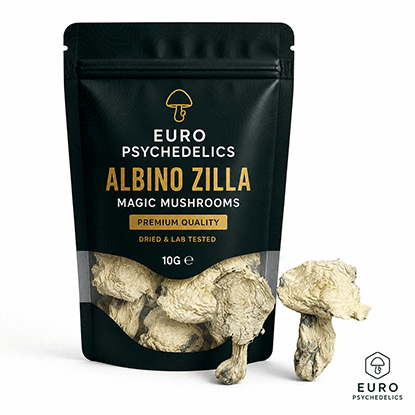
Albino Zilla Magic Mushrooms: Origins, Characteristics, Taxonomy & European Legal Context
Albino Zilla Magic Mushrooms is an informal name used within contemporary psychedelic mushroom culture. The name combines a visual descriptor—Albino—with the lineage-style name Zilla. It should not be treated as the scientific name of a separate mushroom species.
As with other named mushroom varieties, understanding Albino Zilla requires separating informal lineage terminology, fungal taxonomy, morphological characteristics, and legal status. This is particularly relevant for European readers, where legislation concerning psilocybin-containing fungi varies between countries.
What Are Albino Zilla Magic Mushrooms?
Albino Zilla is generally presented as a named lineage or variety-style designation associated with pale or reduced-pigmentation psychedelic mushrooms.
The word Albino refers to the mushroom’s appearance, while Zilla functions as the distinguishing lineage name. Neither term constitutes a formal scientific species classification.
Where a particular Albino Zilla lineage is identified as Psilocybe cubensis, its scientific classification belongs to the recognised species Psilocybe cubensis.
It is important, however, not to assume that a common name alone proves the identity of a particular specimen.
Understanding the “Albino” Description
The term “albino” is widely used in modern mushroom communities to describe unusually pale specimens.
Biologically, pigmentation can vary because of genetic differences affecting the production or distribution of pigments. Some pale mushroom lineages are more accurately described as leucistic, meaning that pigmentation is reduced rather than completely absent.
For this reason, “albino” in mushroom terminology is often a descriptive community term rather than a precise taxonomic classification.
A mushroom can therefore have an “albino” name while still belonging to the same species as normally pigmented specimens.
What Does “Zilla” Mean?
Zilla is best understood as part of the informal name used to distinguish this particular lineage.
Unlike a geographical name such as Amazonian or Mexican, “Zilla” does not clearly identify a specific natural location.
It is therefore more useful to regard the complete name Albino Zilla as a modern lineage-style designation.
Informal mushroom names can originate from many sources, including:
- visual characteristics;
- lineage history;
- community naming;
- geographical associations;
- cultural references;
- individual breeder or collector terminology.
Without documented provenance, the name alone cannot establish the precise genetic history of a specimen.
Taxonomy and Psilocybe cubensis
Where Albino Zilla refers to a Psilocybe cubensis lineage, the relevant scientific classification is:
- Kingdom: Fungi
- Phylum: Basidiomycota
- Class: Agaricomycetes
- Order: Agaricales
- Genus: Psilocybe
- Species: Psilocybe cubensis
Psilocybe cubensis is a recognised fungal species.
Albino Zilla, by comparison, is a common or lineage-style name and should not be presented as though it were an independently recognised species.
Species, Strain and Lineage
The terminology surrounding named mushrooms can be confusing.
A species is a formal taxonomic category.
A lineage describes a group connected through ancestry or shared genetic characteristics.
The word strain is commonly used informally in mushroom communities, although its biological meaning can be less precise than people sometimes assume.
Consequently, describing Albino Zilla as a “strain” in a casual context does not mean that it represents a scientifically recognised species.
Appearance and Morphology
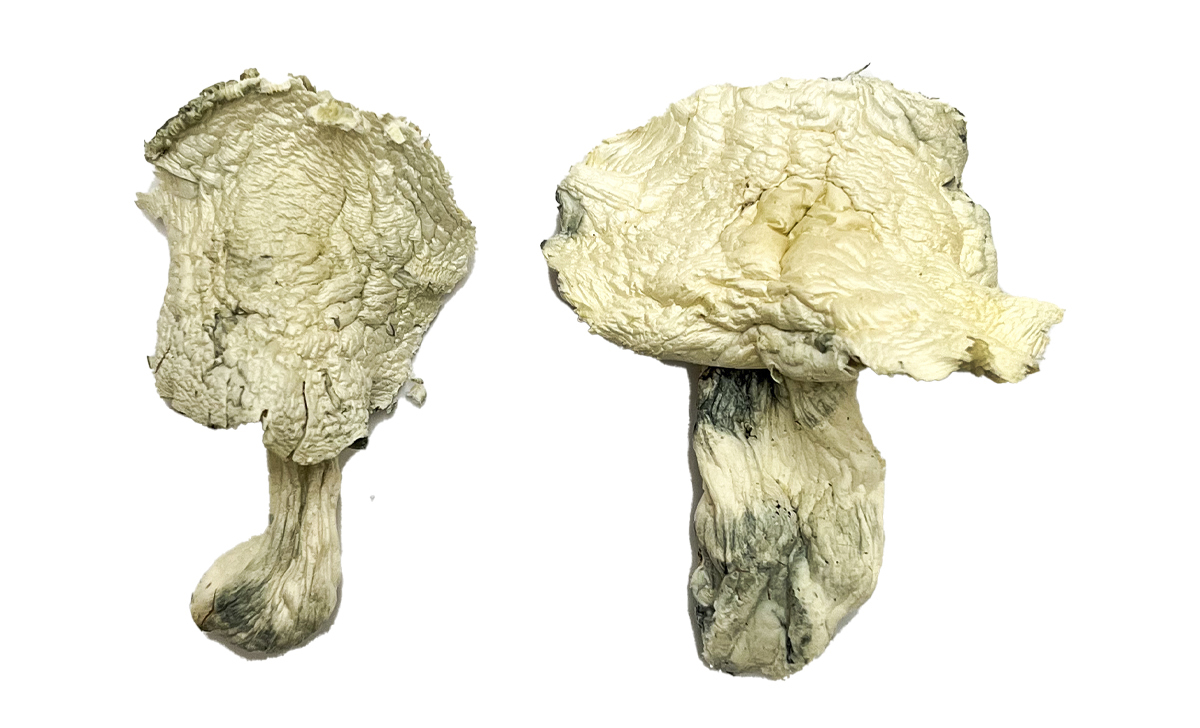
The “Albino” component of the name suggests that appearance is an important characteristic of the lineage.
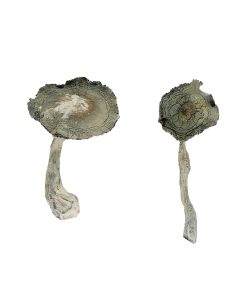
Pale Psilocybe cubensis forms may display:
- very light caps;
- pale stems;
- reduced pigmentation;
- contrasting darker spores.
However, individual mushrooms can vary considerably.
Maturity, genetics and environmental conditions can influence:
- cap shape;
- colour;
- stem form;
- overall size;
- surface appearance.
Therefore, visual characteristics alone cannot definitively establish that a mushroom belongs to the Albino Zilla lineage.
Pale Mushrooms and Dark Spores
One of the interesting features of some pale Psilocybe mushrooms is the contrast between their light-coloured fruiting bodies and darker spores.
The pigments present in the mushroom’s tissues are biologically different from the compounds responsible for spore colour.
Consequently, a mushroom with very pale tissue can still produce dark spores.
This is one reason albino-associated mushroom lineages are visually distinctive and of interest within modern mycology communities.
Mushroom Identification
Scientific mushroom identification involves considerably more than a common name.
Depending on the organism, researchers can examine:
- macroscopic morphology;
- microscopic structures;
- spore characteristics;
- ecological habitat;
- geographic distribution;
- DNA sequences.
A name such as Albino Zilla can indicate how a mushroom is described within a community, but it cannot independently verify its biological identity.
This distinction is particularly important because informal lineage names are not standardised across all mushroom communities.
Psilocybin and Psilocin
When Albino Zilla refers to Psilocybe cubensis, the scientific interest surrounding the mushroom is associated with naturally occurring compounds including psilocybin and psilocin.
Psilocybin is metabolised into psilocin within the human body. Psilocin interacts with serotonin receptors and can produce significant changes in perception, cognition and subjective experience.
Researchers have investigated these compounds in areas such as:
- neuroscience;
- psychology;
- consciousness;
- perception;
- emotional processing;
- psychiatric research.
Research findings should be interpreted within controlled scientific contexts rather than as evidence that every named lineage has identical properties.
Variation in Chemical Composition
The chemical profile of fungi can vary between individual specimens.
Genetics, developmental stage and environmental factors can all influence biological and chemical characteristics.
As a result, a lineage name should not be interpreted as a precise laboratory specification.
Claims concerning potency or chemical composition require appropriate scientific testing rather than relying solely on a common name or anecdotal reports.
Albino Zilla and Modern Mushroom Culture
Albino Zilla belongs to a broader culture of named mushroom lineages.
Modern mushroom communities have developed extensive terminology for distinguishing visually or genetically interesting forms.
Names may reference:
- appearance;
- mythology;
- geography;
- popular culture;
- individual people;
- lineage history.
This naming culture has helped enthusiasts document and discuss fungal diversity, but it does not replace formal scientific taxonomy.
Why Informal Names Persist
Common names can be valuable because they are easy to remember and can preserve community knowledge.
However, they can also change meaning over time.
A particular name may be used differently by different communities, and information about its origin may become difficult to verify.
This is why scientific names such as Psilocybe cubensis are preferable when discussing established biological facts.
Modern Scientific Research
Psilocybin has attracted substantial scientific interest in recent decades.
Researchers have studied its relationship with:
- brain activity;
- perception;
- cognition;
- emotional processing;
- consciousness;
- depression;
- addiction;
- potential therapeutic mechanisms.
Some clinical research has produced promising findings, but research remains subject to scientific and regulatory controls.
Clinical research conditions are also substantially different from uncontrolled environments. Studies generally involve participant screening, defined protocols and professional oversight.
European Legal Context
For European readers, the name Albino Zilla does not determine legal status.
If the underlying mushroom contains controlled compounds such as psilocybin or psilocin, applicable legislation depends on the country concerned.
The European Union Drugs Agency explains that psilocybin and psilocin are controlled under international drug-control conventions, while national approaches to mushrooms containing these substances differ across European countries.
Some jurisdictions specifically regulate mushrooms, while others focus on the controlled compounds they contain.
Therefore, giving a mushroom a different lineage name does not automatically alter its legal classification.
European Laws Can Differ
Drug laws across Europe are not identical.
Depending on the jurisdiction, legislation may address:
- possession;
- cultivation;
- importation;
- distribution;
- preparation;
- research;
- medical applications.
Rules can also change over time.
For this reason, historical information or community discussions should not be relied upon as definitive current legal guidance.
For a country-specific question, the relevant national authority or current legislation should be consulted.
Scientific Research Versus Medical Approval
The increased scientific interest in psilocybin sometimes leads to confusion about its regulatory status.
Research does not automatically mean that a substance has been approved for general medical use.
Clinical trials operate within specific regulatory frameworks and are designed to answer particular scientific questions.
The European Union Drugs Agency notes that psychedelic substances remain subject to international control and that national approaches differ.
Consequently, scientific research into psilocybin should not be interpreted as blanket approval of Albino Zilla or other mushroom lineages.
Health and Safety Considerations
Psilocybin-containing mushrooms can cause substantial alterations in perception and psychological state.
Potential unwanted effects may include:
- anxiety;
- panic;
- confusion;
- nausea;
- impaired judgement;
- distressing perceptual experiences;
- temporary physiological changes.
Individual reactions can differ significantly.
The European Union Drugs Agency has highlighted concerns about unregulated psychedelic practices and potential risks for vulnerable individuals, including people with pre-existing mental-health difficulties.
Accurate fungal identification is also important because poisonous mushrooms can sometimes be mistaken for unrelated species.
Albino Zilla: A Modern Lineage Name
The most accurate way to describe Albino Zilla is as a modern informal lineage or variety-style name, potentially associated with Psilocybe cubensis.
The name itself does not establish:
- a separate species;
- a guaranteed genetic profile;
- a specific chemical composition;
- a particular geographical origin;
- a particular legal status.
Those questions require separate evidence.
Why Albino Zilla Is Interesting From a Mycological Perspective
Albino-associated lineages provide an interesting example of phenotypic variation in fungi.
Reduced pigmentation can create striking visual differences while the organism remains within the same broader species.
This demonstrates an important principle in biology:
Visible differences do not necessarily indicate species-level differences.
Genetic variation within species can produce substantial differences in appearance without creating a new taxonomic category.
The Broader Importance of Fungal Diversity
The study of named mushroom lineages also sits within the much larger field of mycology.
Fungi are essential components of ecosystems and contribute to:
- decomposition;
- nutrient cycling;
- soil ecology;
- plant relationships;
- biodiversity.
Psychedelic fungi represent only a small fraction of global fungal diversity.
Understanding them therefore benefits from a broader ecological perspective rather than focusing exclusively on their psychoactive properties.
Frequently Asked Questions
1. What are Albino Zilla Magic Mushrooms?
Albino Zilla Magic Mushrooms is an informal name used for a pale or albino-associated psychedelic mushroom lineage. Where the lineage is associated with Psilocybe cubensis, that is the relevant scientific species.
2. Is Albino Zilla a separate mushroom species?
No. Albino Zilla is a lineage-style or common name rather than a formally recognised scientific species.
3. Why are they called “Albino”?
The name refers to their characteristically pale appearance and reduced pigmentation. In mushroom terminology, “albino” can sometimes be used broadly for forms that may be more accurately described as leucistic.
4. What species are Albino Zilla mushrooms associated with?
The name is generally discussed in connection with Psilocybe cubensis. However, a common name alone cannot definitively establish the identity of an individual specimen.
5. Do pale mushrooms have different biology from normally coloured mushrooms?
Not necessarily. Differences in pigmentation can result from genetic variation without changing the organism’s species classification.
6. Are Albino Zilla Magic Mushrooms legal in Europe?
There is no single answer for every European country. Psilocybin and psilocin are internationally controlled, while national legislation concerning mushrooms containing these substances varies between jurisdictions.
| Quantity | 7grams, 14grams, 28grams |
|---|
Be the first to review “Albino Zilla Magic Mushrooms”
Related products
Magic Mushrooms
Magic Mushrooms
Magic Mushrooms
Magic Mushrooms
Magic Mushrooms
Magic Mushrooms
Magic Mushrooms
Magic Mushrooms
Reviews
There are no reviews yet.