
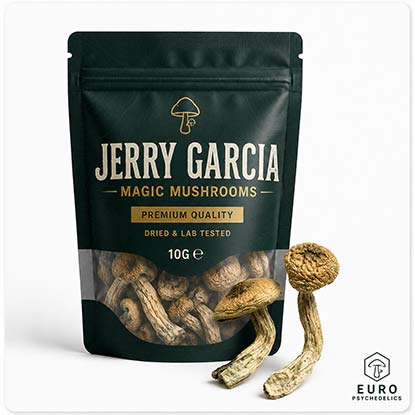
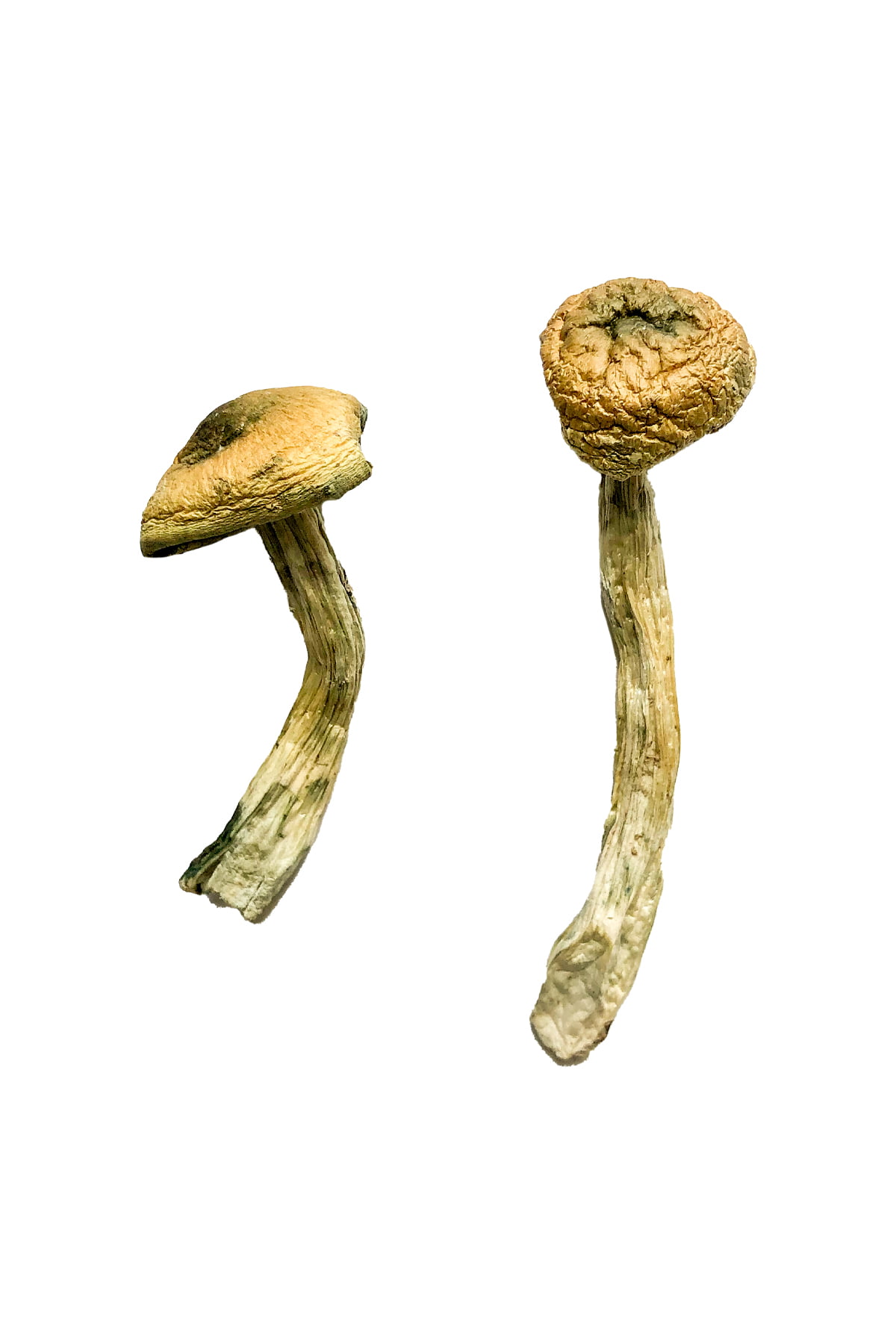

Jerry Garcia Magic Mushrooms: Origins, Naming, Characteristics & European Legal Context
Jerry Garcia Magic Mushrooms is a name encountered within modern psychedelic mushroom culture. Unlike a formal scientific species name, “Jerry Garcia” is a named variety or lineage-style designation. The name itself does not establish a distinct fungal species, precise genetic history, geographic origin, or chemical profile.
The name is also culturally significant because it references Jerry Garcia, the American musician best known as a founding member and guitarist of the Grateful Dead. His association with the counterculture of the 1960s and subsequent psychedelic culture helps explain why his name can appear in terminology surrounding psychedelic mushrooms.
However, cultural association should not be confused with scientific provenance. There is no basis for assuming that a mushroom carrying the Jerry Garcia name was collected by, cultivated by, or otherwise directly associated with Garcia himself.
What Are Jerry Garcia Magic Mushrooms?
“Jerry Garcia Magic Mushrooms” is best understood as a popular name used within psychedelic mushroom culture, rather than the scientific designation of a unique species.
Formal fungal taxonomy uses scientific names based on recognised classification systems. A named variety can exist within a particular species without representing a separate species.
This means that the name “Jerry Garcia” alone cannot establish:
- the exact species;
- genetic lineage;
- geographic origin;
- concentration of naturally occurring compounds;
- historical provenance; or
- legal status.
These are separate questions requiring separate evidence.
The Cultural Meaning Behind the Name
The name Jerry Garcia has a strong association with psychedelic-era music and American counterculture.
Garcia and the Grateful Dead became closely associated with the broader countercultural movement of the 1960s and 1970s. Psychedelic experiences, experimental music and alternative cultural movements overlapped significantly during that period.
That cultural history is relevant when examining why psychedelic mushroom varieties sometimes receive names associated with musicians, artists and counterculture figures.
Nevertheless, a modern mushroom name using a famous person’s name should not automatically be interpreted as an officially documented historical connection.
Scientific Taxonomy Versus Popular Names
The distinction between scientific species names and popular variety names is particularly important for mushroom research.
For example, Psilocybe cubensis is a recognised fungal species that is widely associated with the term “magic mushroom.”
A name such as Jerry Garcia does not function in the same taxonomic way.
It may identify a particular community-recognised lineage or phenotype, but the name itself does not establish formal scientific classification.
Why this distinction matters
Online mushroom information can sometimes blur these categories.
A named variety may have:
- a widely repeated description;
- photographs;
- community discussions;
- cultivation histories;
- claims about genetics; or
- anecdotal reports.
None of these automatically establishes scientific taxonomy.
For authoritative information, species identification should be supported by appropriate mycological evidence.
Understanding Mushroom Lineages
A lineage refers broadly to genetic ancestry or descent within a population.
Named mushroom lineages can develop through historical collection, propagation and community naming.
Over time, a lineage can acquire a distinctive identity and become recognised by hobbyists even though its name is not formally recognised by scientific taxonomy.
This is similar to the distinction between a cultivar or named variety and a biological species in other areas of horticulture and biology.
A named lineage can be culturally meaningful without constituting a separate species.
Appearance and Phenotype
Mushrooms can display substantial variation in appearance.
Researchers may consider characteristics such as:
- cap morphology;
- pigmentation;
- stem structure;
- gill arrangement;
- surface texture;
- developmental stage; and
- other physical features.
These characteristics form part of an organism’s observable phenotype.
Importantly, phenotype does not necessarily equal species.
Two mushrooms can look different while belonging to the same species, while unrelated species can sometimes exhibit superficially similar characteristics.
Psilocybin and Psilocin
The broader term “magic mushrooms” commonly refers to fungi associated with the naturally occurring psychedelic compounds psilocybin and psilocin.
Psilocybin is metabolised in the human body into psilocin, which contributes to the psychedelic effects associated with these compounds.
Scientific research into psilocybin has expanded considerably, particularly in neuroscience and mental-health research.
Studies have investigated areas including:
- perception;
- consciousness;
- brain activity;
- mood;
- psychotherapy;
- depression;
- anxiety; and
- other psychiatric conditions.
Research findings should nevertheless be interpreted within the controlled environments in which they were obtained.
Can a Mushroom Name Establish Its Potency?
No.
A name such as “Jerry Garcia” cannot by itself establish the concentration of psilocybin or psilocin in a mushroom.
Chemical composition can vary due to biological and environmental factors.
Consequently, precise claims about potency should not be inferred simply from a named variety.
Where chemical composition is scientifically important, laboratory analysis is substantially more informative than a popular name.
Why Mushroom Identification Requires Care
Mushroom identification can be difficult even for experienced observers.
Visual appearance can change with:
- age;
- environmental conditions;
- genetics;
- moisture;
- development; and
- other biological factors.
Scientific identification may therefore involve multiple forms of evidence.
Macroscopic examination
Researchers can assess visible characteristics such as caps, stems and gills.
Microscopic examination
Microscopy can reveal structures that are not visible in ordinary photographs.
Molecular methods
DNA-based analysis can provide additional evidence about species identity and genetic relationships.
This is why a community name should not be treated as definitive taxonomic evidence.
Jerry Garcia and Psychedelic Culture
The cultural history surrounding Jerry Garcia is relevant to understanding the name.
Garcia became an influential figure in American music and counterculture, while the Grateful Dead developed a particularly strong association with psychedelic-era culture.
The band’s audience, known as “Deadheads,” developed a distinctive cultural identity that extended beyond music.
Psychedelic culture subsequently became associated with a broad range of art, music, literature and social movements.
Modern mushroom naming sometimes reflects this history by using names connected to influential figures from psychedelic and countercultural traditions.
Historical Association Versus Provenance
It is important to distinguish between cultural association and biological provenance.
The fact that a mushroom variety has been named after Jerry Garcia does not demonstrate that Garcia himself had a role in its development.
Likewise, the name does not establish where a particular mushroom specimen originated.
Provenance requires documented evidence such as collection records, genetic history or other reliable sources.
This distinction is especially useful when evaluating online claims about named mushroom varieties.
Modern Psychedelic Research
Interest in psychedelic science has grown substantially.
Researchers are investigating compounds such as psilocybin to better understand their effects on the brain and their potential therapeutic applications.
European institutions are participating in this growing research field.
The European Union Drugs Agency has highlighted increasing interest in psychedelic substances while also discussing their regulatory and public-health implications.
Scientific research should therefore be distinguished from informal claims about particular mushroom varieties.
European Legal Context
The legal status of psilocybin-containing mushrooms varies across Europe.
There is no single European rule that applies identically to every country.
The European Union Drugs Agency notes that psilocybin and psilocin are controlled under the 1971 United Nations Convention on Psychotropic Substances.
Individual European countries implement their own legislation, and their approaches can differ.
Depending on the jurisdiction, regulations may concern:
- possession;
- cultivation;
- preparation;
- importation;
- distribution;
- supply;
- the form of the material; and
- the controlled compounds involved.
Why country-specific information matters
It would therefore be inaccurate to describe Jerry Garcia Magic Mushrooms as universally legal or illegal throughout Europe.
Anyone researching the legal position should consult current legislation and the appropriate competent authority in their specific country.
Health Considerations
Psychedelic mushrooms can produce significant alterations in perception, cognition and mood.
Individual responses can differ considerably.
Potential concerns include:
- anxiety;
- confusion;
- impaired judgement;
- psychological distress; and
- unexpected psychological reactions.
There are also risks associated with incorrect mushroom identification because visually similar fungi can have very different properties.
Questions involving medication, mental health or potential interactions are best addressed with a qualified healthcare professional.
Why Named Mushrooms Need Careful Documentation
Jerry Garcia is a good example of why popular mushroom terminology needs to be interpreted carefully.
There are several layers of information:
Popular name: Jerry Garcia.
Cultural reference: associated with a major figure in psychedelic-era music.
Taxonomy: requires identification of the actual fungal species.
Genetics: requires evidence concerning lineage.
Chemistry: requires appropriate analytical information.
Legality: depends on the applicable national law.
None of these categories automatically proves the others.
Jerry Garcia Magic Mushrooms in Context
The term Jerry Garcia Magic Mushrooms sits at the intersection of fungal culture, psychedelic history and modern naming practices.
Its cultural significance comes partly from the connection between Jerry Garcia and the psychedelic counterculture surrounding the Grateful Dead.
Scientifically, however, the name should be treated as a popular lineage-style designation rather than automatically as a unique species.
For European audiences, legal information should always be presented country by country because regulations concerning psilocybin, psilocin and mushrooms containing these compounds differ between jurisdictions.
A scientifically responsible discussion therefore separates cultural history, taxonomy, chemistry and law, rather than treating a popular mushroom name as evidence for all four.
Frequently Asked Questions
1. What are Jerry Garcia Magic Mushrooms?
Jerry Garcia Magic Mushrooms is a popular name associated with modern psychedelic mushroom culture. It is a lineage-style or variety name rather than, by itself, the formal scientific name of a distinct fungal species.
2. Why are these mushrooms called Jerry Garcia?
The name references Jerry Garcia, the influential guitarist and founding member of the Grateful Dead, whose music and cultural legacy became strongly associated with psychedelic-era counterculture. The name should not automatically be interpreted as evidence of Garcia’s involvement with a particular mushroom lineage.
3. Is Jerry Garcia a scientific mushroom species?
No. “Jerry Garcia” is not a formal scientific species name. Scientific classification requires an appropriate genus and species designation supported by taxonomic evidence.
4. Does the Jerry Garcia name indicate a particular potency?
No. A popular mushroom name cannot reliably establish the concentration of psilocybin, psilocin or other compounds. Chemical composition requires appropriate analytical evidence.
5. Are Jerry Garcia Magic Mushrooms legal in Europe?
There is no universal European answer. Laws concerning psilocybin, psilocin and mushrooms containing these substances vary between countries. Current legislation should be checked for the specific European jurisdiction.
6. Why is it important to distinguish mushroom names from scientific taxonomy?
Popular names can describe lineages, phenotypes, cultural associations or commercial terminology without representing formal species. Separating popular terminology from scientific taxonomy helps prevent unsupported claims about identity, genetics, chemistry and origin.
| Quantity | 14grams, Oz, Qp, Hp, 1p |
|---|
Be the first to review “Jerry Garcia Magic Mushrooms”
Related products
Magic Mushrooms
Magic Mushrooms
Magic Mushrooms
Magic Mushrooms
Magic Mushrooms
Magic Mushrooms
Magic Mushrooms
Magic Mushrooms
Reviews
There are no reviews yet.